Richard Misrach on the Beach Art Institute of Chicago
/

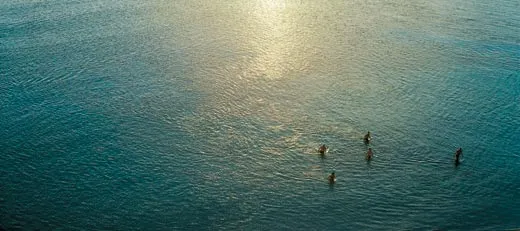
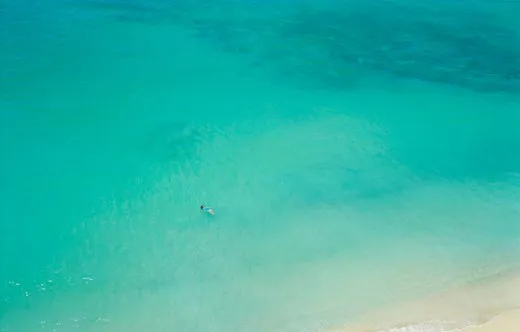
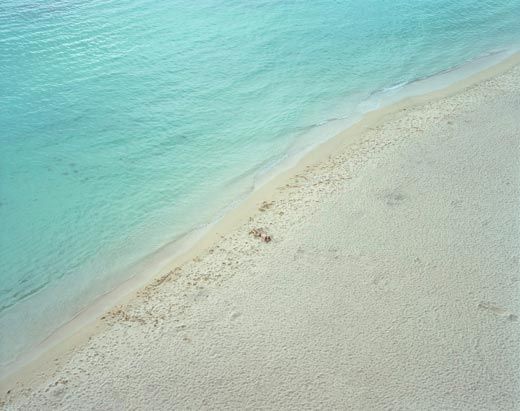
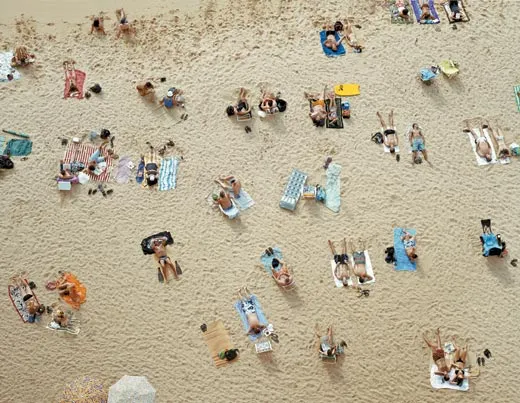
Richard Misrach, Untitled 1132-04, 2004-Misrach says he began to discover how "people group upwards and leave a sort of comfortable infinite around them—something that maybe would only be revealed when you stand back to see information technology." Courtesy of Fraenkel Gallery, SF, Marc Selwyn Art, LA, and Step/ MacGill Gallery, NY

/

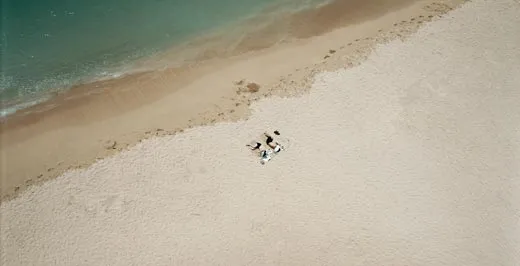
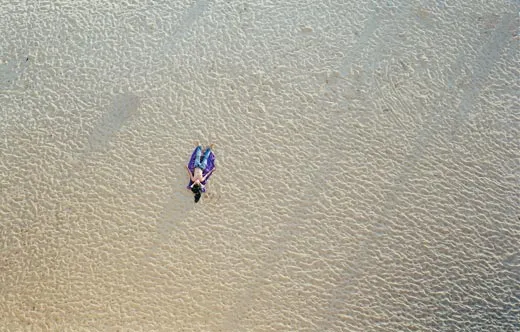
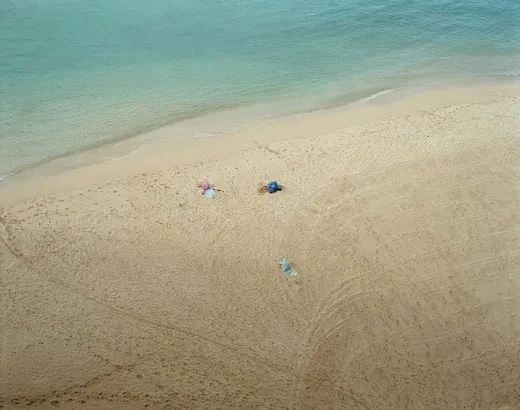
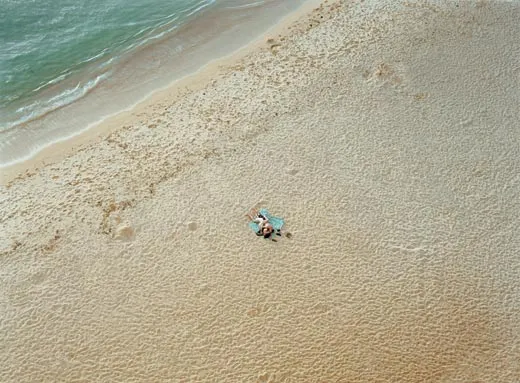
Richard Misrach, Untitled 696-05, 2005-A "satellite" view, says Misrach, hints at "surveillance or even voyeurism." The scene is romantic, just the couple is also isolated. "It'south kind of like the end of the world." Courtesy of Fraenkel Gallery, SF, Marc Selwyn Fine Art, LA, and Pace/ MacGill Gallery, NY

/

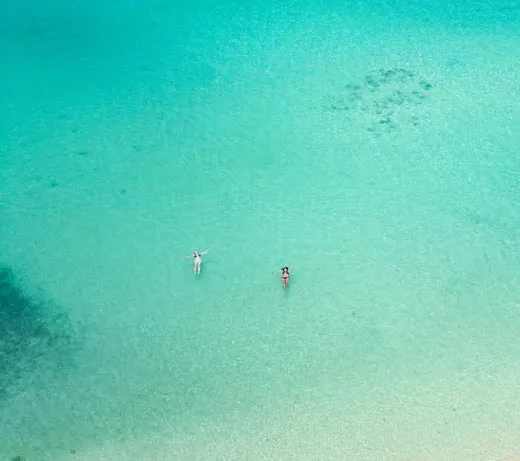
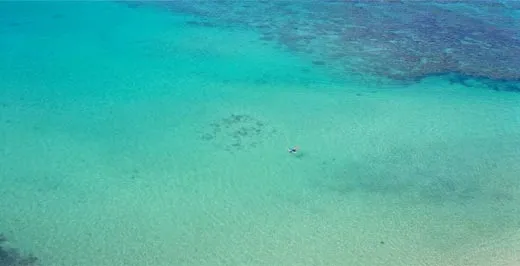
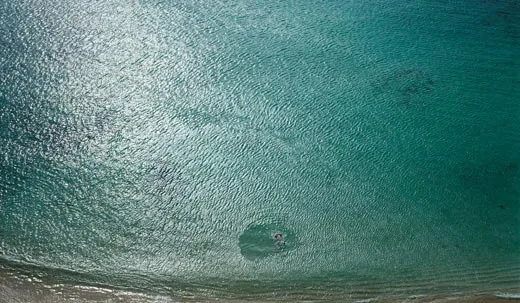
Richard Misrach, Untitled 192-03, 2003-After 9/11, Misrach began seeing people in the body of water as quite vulnerable. "They were having a proficient fourth dimension," he says, "but at that place was a weird tension." In the image at left, for example, the swimmers' gestures conveyed to him a sense of flight from some unknown threat. Without a context, he says, "you just encounter this vast sea and these people." Courtesy of Fraenkel Gallery, SF, Marc Selwyn Fine Art, LA, and Pace/ MacGill Gallery, NY

/

Richard Misrach, Untitled 394-03, 2003, 2004-The largest of the "On the Beach" drove measures 6 by ten anxiety. Drove of the Richard Misrach. Courtesy Fraenkel Gallery, San Francisco; Pace/MacGill Gallery, New York and Marc Selwyn Fine Arts, Los Angeles

/

Richard Misrach, Untitled 586-04, 2004-Misrach says he set out to "capture moments when they [people] weren't as comfy in the ocean equally you might call back. Collection of the Richard Misrach. Courtesy Fraenkel Gallery, San Francisco; Pace/MacGill Gallery, New York and Marc Selwyn Fine Arts, Los Angeles

/

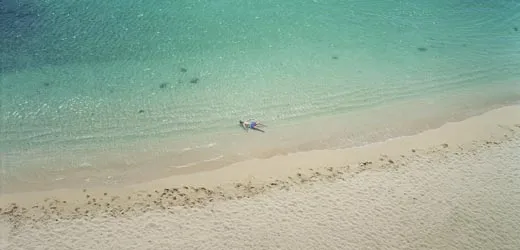
Richard Misrach, Untitled 591-04, 2004-"Even his picture of a alone couple on a beach can be vaguely unsettling: their isolation underscores their vulnerability." Drove of the Richard Misrach. Courtesy Fraenkel Gallery, San Francisco; Footstep/MacGill Gallery, New York and Marc Selwyn Fine Arts, Los Angeles

/

Richard Misrach, Untitled 627-02, 2002-According to Misrach, "On the Beach" is "about how people are able, in the face of huge tragedy, continue on and practice things and have a good time and play and relax on the beach." Collection of the Richard Misrach. Courtesy Fraenkel Gallery, San Francisco; Pace/MacGill Gallery, New York and Marc Selwyn Fine Arts, Los Angeles

/

Richard Misrach, Untitled 704-03, 2003-"On the Beach" was hard work for Misrach. Many hours were spent in the sun waiting for something to happen. Drove of the Richard Misrach. Courtesy Fraenkel Gallery, San Francisco; Pace/MacGill Gallery, New York and Marc Selwyn Fine Arts, Los Angeles

/

Richard Misrach, Untitled 857-02, 2002-Misrach says "that [he] saw people being more than vulnerable in the ocean." Collection of the Richard Misrach. Courtesy Fraenkel Gallery, San Francisco; Footstep/MacGill Gallery, New York and Marc Selwyn Fine Arts, Los Angeles

/

Richard Misrach, Untitled 892-03, 2003-Shooting from the balustrade Misrach says "was totally fascinating." Collection of the Richard Misrach. Courtesy Fraenkel Gallery, San Francisco; Stride/MacGill Gallery, New York and Marc Selwyn Fine Arts, Los Angeles

/

Richard Misrach, Untitled 1179-04, 2004-"Richard Misrach: On the Beach," is currently at the National Gallery through Sept. 1, then the exhibition travels to the Henry Art Gallery and the Loftier Museum of Art in Atlanta, Ga. Collection of the Richard Misrach. Courtesy Fraenkel Gallery, San Francisco; Step/MacGill Gallery, New York and Marc Selwyn Fine Arts, Los Angeles

/

Richard Misrach, Untitled 1139-03, 2003-Misrach traveled for years in the desert taking pictures and chasing the light. "On the Beach is just the opposite, staying in one place with the idea that the pictures accept to manifest themselves." Collection of the Richard Misrach. Courtesy Fraenkel Gallery, San Francisco; Pace/MacGill Gallery, New York and Marc Selwyn Fine Arts, Los Angeles

You might remember that Richard Misrach took the photographs on these pages while hovering over different beaches around the world. But he actually shot them all from the same high-ascension hotel in Hawaii. Misrach, a 59-year-old fine arts photographer known for his pioneering work with colour and unsparing images of the despoiled American West, says he enjoyed the lofty perspective from the hotel's balconies: "I always idea about it as being a god'southward-heart view, looking down and seeing these amazing human interactions."

Though the connection may not be obvious, his pictures of people relaxing and playing were deeply influenced by the events of September eleven, 2001. That morn, Misrach, who lives in Berkeley, California, happened to exist in Washington, D.C., which was shaken by the attack on the Pentagon, and he was anxious about his son, Jake, and then a freshman at New York Academy. He finally reached Jake and was able, a few days later, to drive upward to Manhattan. "I went in at night by blockades and got into the city," he says. "There was still ash falling from the sky. It was really eerie. I found Jake and took him to a friend's house exterior the city."

Later on returning to California, Misrach decided to become ahead with a planned trip with his married woman, Myriam, to Hawaii, where they had often vacationed. Just he was "haunted by the whole feel in New York," he said at the Art Found of Chicago (the show's organizer). "It changed the manner I looked at everything." Then even his picture of a lone couple on a beach tin can exist vaguely unsettling: their isolation underscores their vulnerability, and the photographer's long-range viewpoint is clearly that of someone watching. It's no accident that the title Misrach gave to the exhibition and volume of photographs taken in Hawaii over four years is "On the Beach," from the 1957 Nevil Shute novel almost life after a nuclear holocaust.

The photographs are, in a give-and-take, stunning: the largest measure out half-dozen by 10 anxiety and are so detailed y'all can read the headlines on a beachgoer'due south paper. To create the pictures, Misrach used a view camera that holds 8-by-10-inch negatives, which, he says, "give you a level of definition that y'all'd never get with a 35-millimeter photographic camera." He scanned the negatives into a computer, and sometimes digitally removed people, heightening the feeling of isolation. When he was satisfied with an prototype, it was burned with lasers onto photographic paper that then went through a chemical developing process.

These ambiguous pictures would appear to be a divergence from his all-time-known series, including the politically overt "Cancer Alley" of 2000, which exposed industrial pollution along the Mississippi River, and his 1990 "Bravo 20," nigh the devastating ecology effects of bomb tests at a U.S. Navy range in Nevada. The beach images "seem much more than beautiful, almost in a way more soft than some of his other work," says Sarah Greenough, photography curator at the National Gallery of Fine art in Washington, D.C., where the bear witness is on view through September 1, earlier moving to the Henry Art Gallery in Seattle and the High Museum of Fine art in Atlanta. "After you look at them for a while, though, they are inappreciably soft at all. There really is something very ominous going on."

Misrach says the new piece of work is of a piece with his focus on people and the environment. But, he says, "it is much more about our human relationship to the bigger sublime picture of things."

Kenneth R. Fletcher is the magazine'southward editorial intern.

reibeyladmis.blogspot.com

Source: https://www.smithsonianmag.com/arts-culture/richard-misrachs-ominous-beach-photographs-979981/

0 Response to "Richard Misrach on the Beach Art Institute of Chicago"

Post a Comment

Iklan Atas Artikel

Iklan Tengah Artikel 1

Iklan Tengah Artikel 2

Iklan Bawah Artikel